Dryer Vent Hood Covers: A Flap, Not a Screen
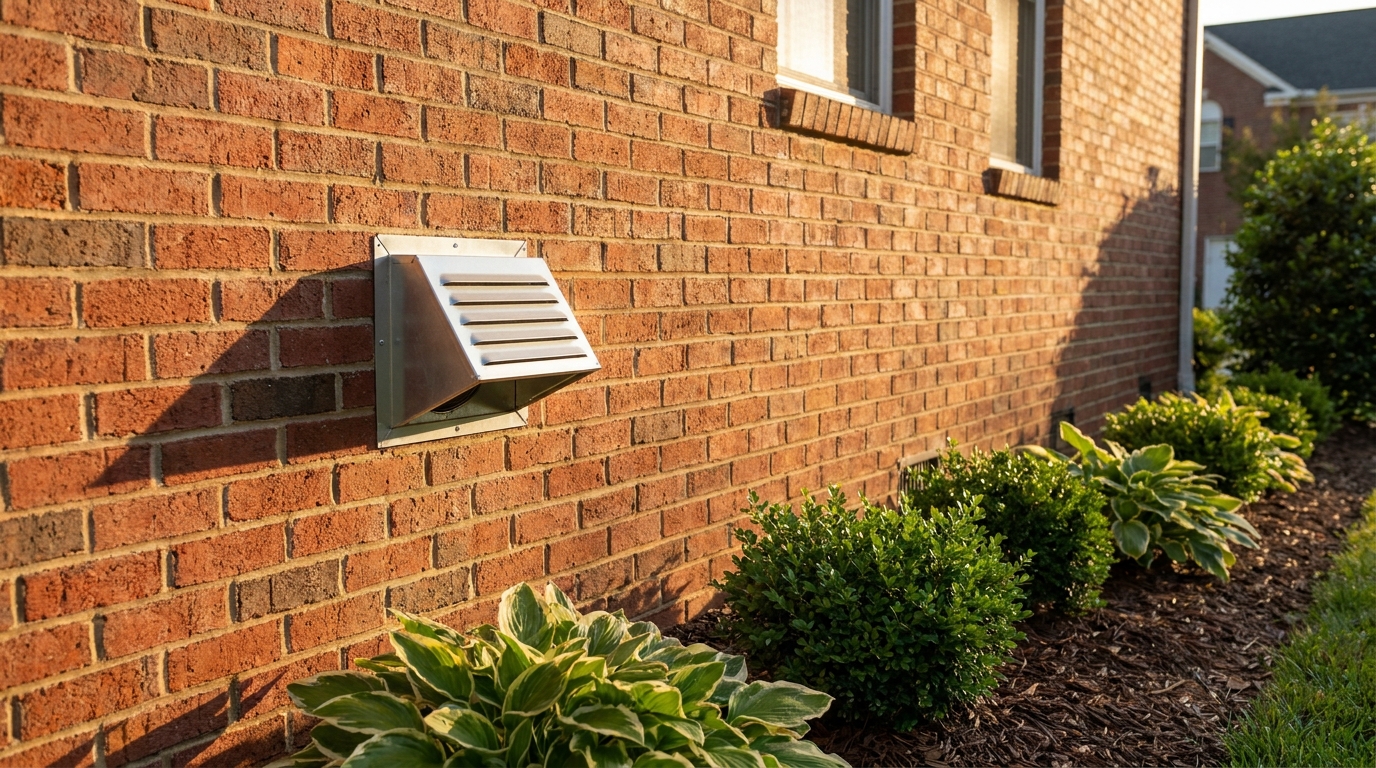
Dryer vent hood covers fail in ordinary ways on houses in Indian Trail: the flap sticks, the hood is missing, or someone has fastened a mesh guard over the outlet. Any of those can stop exhaust air even when the duct in the wall is still open. The 2024 North Carolina residential code requires that termination to sit outdoors, to include a backdraft damper, and to have no screen at the duct termination or the weather cap outlet [1]. The cover that meets that rule is a hood whose flap opens under dryer airflow and closes when the dryer stops.
The hood, the flap, and the opening at the wall
The hood, sometimes called a weather cap, sheds rain and keeps the duct from being an open hole in the siding or the brick. The flap, or backdraft damper, is the moving part. It should lift when the dryer pushes air, then fall closed when the cycle ends. The passageway through that hood has to stay large enough for the air and the lint that rides with it.
The 2021 International Residential Code says exhaust ducts shall terminate outside, that terminations shall have a backdraft damper, and that screens shall not be installed at the duct termination [2]. The passageway shall be undiminished in size and shall provide an open area of not less than 12.5 square inches [2]. The 2024 International Mechanical Code states the same core rule: terminate outside, use a backdraft damper, and do not install screens at the termination [3].
If the dryer maker names a location, that instruction controls. If it does not, North Carolina requires the outlet to end not less than 3 feet in any direction from openings into buildings [1]. The 2021 IRC includes ventilated soffit openings in that separation [2]. ICC commentary explains why: airflow at a ventilated soffit moves inward, so moist exhaust can be pulled into the attic [4]. North Carolina also requires the duct to terminate not less than 12 inches above finished grade [1]. If the outlet is lower, an areaway of not less than 200 square inches is allowed, and the bottom of the termination still has to sit at least 12 inches above the areaway floor [1]. A hood buried in mulch cannot meet that rule.
The same page notes that the 2018 North Carolina code remains the governing standard until the 2024 code takes effect, unless an owner asks to use 2024 as an alternate [1]. The sentences above are the 2024 text.
ICC commentary on the 2021 IRC says backdraft dampers limit outdoor air infiltration when the dryer is off and prevent animals from entering [4]. They are typically gravity dampers, opened by exhaust force, and they should seal when closed [4]. Some dryer manufacturers prohibit magnetically held dampers because of the extra resistance [4]. A replacement hood has to follow the dryer maker's instructions, which both North Carolina and the IRC put first [1][2].
When the flap is stuck
A flap that will not move is a blockage you can see. Stuck shut, exhaust has nowhere to go. Stuck halfway, the dryer pushes against a half-closed door. Stuck open, it is no longer a damper, and outdoor air can move back into the duct [4].
The U.S. Consumer Product Safety Commission says to check the outside dryer vent while the dryer runs and confirm that exhaust air is escaping [5]. If it is not, the vent or the exhaust duct may be blocked [5]. The U.S. Fire Administration flyer says to make sure the outdoor vent covering opens when the dryer is operating [6]. You should see the flap lift and feel air. A flap that barely twitches is the restriction.
Lint on the hinge or the sealing lip is the usual cause. Paint can glue a flap shut. A dent from a mower, a ladder, or a deck board can pin it. Ice can lock it in a cold snap and leave it bent. None of that, by itself, means the concealed duct has failed.
Inside the house, the clue is time and heat. CPSC notes that clothes still damp after a typical cycle, or drying that takes longer than normal, may mean the lint screen or the exhaust duct is blocked [5]. A Building America guide updated in July 2025 says lint in the vent can block airflow, which increases drying times and can cause the dryer to overheat [7]. A stuck flap does that at the last inch of the run. A flap that stays open is the other fault: clothes may still dry, but outdoor air and debris move through a damper that no longer seals [4].
When the hood itself is missing
A missing hood is not a dirty duct. It is an open collar, a cap that fell off, or a hole where the flap used to be. The code still wants that opening outdoors, with a backdraft damper, and without a screen [1][3].
Rain wets the last few feet of duct. Wet lint sticks, and a short plug at the wall can look like a full-line clog until the hood area is cleared and the duct behind it is empty.
Replace it with a dryer exhaust hood whose damper opens freely and whose passageway stays clear. The mechanical code bars sheet metal screws or other fasteners that obstruct exhaust flow [3]. Set the hood at the height and clearance the code and the dryer instructions require, not down behind a shrub [1]. If air still will not move once the new flap is free, the duct is the next question. Until then, the missing cover is the repair.
Why a mesh guard is the wrong cover
A mesh guard looks like a simple way to keep animals out. The code does not allow it. North Carolina says screens shall not be installed at the duct termination or weather cap outlet [1]. The IRC and the mechanical code forbid screens at the duct termination [2][3].
ICC commentary gives the reason. Lint clogs a screen, resistance builds, and the opening can block completely, which the commentary calls a fire hazard [4]. No type or size of screen is recognized, and there is no exception for a basket-type animal screen [4]. Fibers, hair, strings, and similar debris can coalesce and clog any screen over time [4]. The 2025 Building America guide says the same thing in field language: use a single flap or a louvered flap, not a screen that traps lint, and end the duct outside rather than in an attic or crawl space [7].
A proper hood uses the damper as the closure. The flap or louvers open only while air pushes them. Wire screen, cloth, a pest cage, or hardware cloth over the outlet is still a screen, even if the package says guard. The Fire Administration flyer tells you the outdoor covering has to open [6]. A screen does not open. It loads up. If one is already installed, taking it off is part of the hood repair. The hood and a damper that actually seats are the guard the termination is built to provide [4].
When a hood cover repair is enough
Hood work is enough when the defect is the termination and the duct behind it can still move air.
- The flap is stuck with lint, paint, or a bend, and a strong rush of air comes out once it moves.
- The hood is cracked, rusted, loose, or missing, and the collar behind it is intact.
- A screen, cloth, or cage covers the outlet and needs to come off in favor of a damper hood.
- The flap will not close because the hinge failed, or because a magnetic hold the dryer maker does not allow keeps it from seating [4].
- Mulch, a bin, or a deck board blocks the hood, or the outlet sits too low for the grade clearance in the code [1].
Freeing or replacing that cover, then confirming airflow, is the repair. Clothes dry in less time because the air can leave. You have not opened a wall to replace a duct that was clear.
It is not enough when the flap already moves and the air is still weak. If exhaust air is not escaping, CPSC says the vent or the duct may be blocked [5]. A new hood on a packed line only gives the lint a cleaner door. Plastic or foil accordion duct is a different fault. CPSC says to replace it with rigid or corrugated semi-rigid metal, because plastic and foil trap lint and kink or crush more easily [5]. And a cap on a duct that ends in a crawl space or an attic is not finished work. Both codes require the outlet on the outside of the building [1][3].
MJL Services checks the hood, the flap, and whether air leaves once the damper can move. If the cover is the defect, hood repair or a new hood cover is the work. If the duct is packed, crushed, or ending in the wrong place, the hood is only the start. Our dryer vent service cleans from the dryer to the outside at one low price. Opening a pipe in an attic or a crawl space, when that is required to clean the line, is extra, and you hear that before the extra work starts.
A one-cycle check from the yard
Use one heated cycle, not air fluff.
- Clean the lint screen first so the screen is not the thing you are testing [5].
- Start the dryer and stay out of the hot, damp discharge.
- The flap or louvers should open, and you should feel exhaust air [5][6].
- When the dryer stops, the damper should fall closed on its own [4].
- You should see a hood, not a bare pipe, and not a screen or cage [1][7].
- The outlet should not be buried, and it should not sit against a window, a door, or a soffit vent [1][2].
Wiping lint off a hinge, with the dryer off, is reasonable care. Do not run the dryer with the hood removed, and do not add a screen "for now." If the flap is broken, the hood is missing, you smell heat, or air still will not move, have the termination and the duct checked. Also look behind the dryer. The Fire Administration says that venting should not be damaged, crushed, or restricted [6].
Practical takeaways
- Dryer vent hood covers should be a hood with a backdraft damper. North Carolina forbids screens at the termination and at the weather cap outlet [1].
- A stuck flap can block airflow the way a clogged duct does. The covering should open, and exhaust air should escape, while the dryer runs [5][6].
- A flap that stays open lets outdoor air into the duct between cycles. That is why the damper is required [4].
- A missing hood is a cover repair: a clear passageway and no fastener sticking into the exhaust [2][3].
- The model residential code calls for an open area of not less than 12.5 square inches at the terminal [2].
- Hood repair is enough when a free flap restores strong airflow. Weak air with a free flap means the duct still needs work [5].
- MJL Services will say which it is. You work directly with the owner. We are fully insured, on time, and we do not use high-pressure sales.
How we can help
Have more questions or want to get in touch? Call MJL Services at (704) 288-7316, or use our contact page. We serve homeowners, rental owners, and property managers in Indian Trail, Monroe, and the Charlotte metro, including surrounding Mecklenburg and nearby counties. We repair dryer hood covers, free stuck dampers, remove outlet screens that do not belong there, and clean from the dryer to the outside when the hood is not the whole story. When you hire MJL Services, you work directly with the owner. Fully insured, on time, and no high-pressure sales.
Citations
- International Code Council, "2024 North Carolina State Building Code: Residential Code, M1502.3 Duct termination" (2024)
- International Code Council, "2021 International Residential Code, Chapter 15 Exhaust Systems, Section M1502" (2021)
- International Code Council, "2024 International Mechanical Code, Section 504.4 Exhaust installation" (2024)
- International Code Council, "2021 International Tiny House Provisions, commentary on IRC M1502.3 Duct termination" (2021)
- U.S. Consumer Product Safety Commission, "Overheated Clothes Dryers Can Cause Fires, Publication 5022" (2012)
- U.S. Fire Administration, "Clothes Dryer Fire Safety" (2018)
- Pacific Northwest National Laboratory, Building America Solution Center, "Clean Dryer Exhaust" (2025-07-25)


