Chimney Spark Arrestor: Mesh That Stops Embers
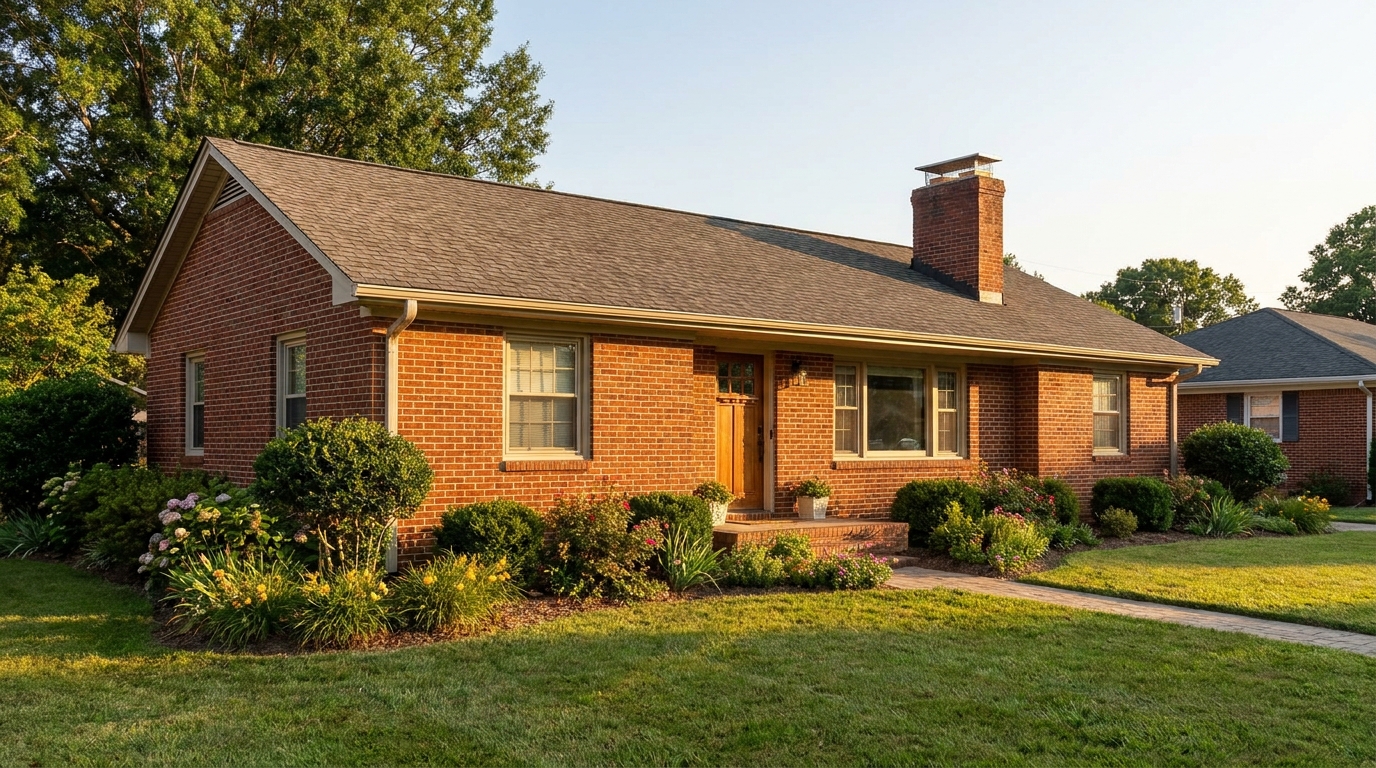
A chimney spark arrestor is the metal mesh on a chimney cap that catches sparks and burning brands before they leave the flue. The screen is there to keep those embers off the roof, out of the gutters, and away from a deck or dry leaves. It is a different piece from a solid rain cover, and a wide animal guard is not the same screen. Where a spark arrestor is installed on a masonry chimney, the 2018 North Carolina Residential Code says the openings shall not pass a sphere larger than 1/2 inch and shall not block a sphere smaller than 3/8 inch [1].
What a chimney spark arrestor stops
A working chimney drafts. The same pull that carries smoke can carry small glowing pieces onto shingles, into a gutter, or onto a deck. The spark arrestor is the screen at the outlet. It stops the ember while smoke still has a way out.
The Federal Alliance for Safe Homes describes the risk directly. Embers flying from a chimney can collect on vegetation or on ignitable surfaces such as wood decks or roofs, and the mesh is meant to catch those escaping embers before they ignite what they land on [2]. In Indian Trail, Monroe, and the Charlotte metro, pine straw and leaves often sit on those same shingles and in the gutters. The spark only needs a dry spot within a short drop of the cap.
The heating-fire totals that follow cover heating fires as a group, not missing screens. The U.S. Fire Administration's 2024 estimates counted 27,200 residential building heating fires, 145 deaths, 475 injuries, and $445,900,000 in property loss [4]. The same page reports a 26 percent decrease in those fires from 2015 to 2024, so the count has fallen, and it has not fallen to zero [4].
A 2017 to 2019 U.S. Fire Administration report found that chimney or flue fires confined to the chimney or flue accounted for 49.43 percent of residential building heating fires [5]. A fire that stays inside the flue is not the same event as a roof fire started by a spark that got out. The screen is aimed at the brand that clears the top.
Newer loss figures point the same direction. Based on 2020 to 2024 annual averages, the National Fire Protection Association reports that the larger, non-confined fires involving fireplaces or chimneys were involved in 6 percent of home heating-equipment fires and caused 19 percent of the direct property damage from those fires [6]. A screen does not replace every other precaution. In those same averages, space heaters and heating stoves accounted for 30 percent of the fires, 73 percent of the deaths, and 70 percent of the injuries [6]. The mesh only does its narrower job if the holes are the right size and still open.
How the screen differs from an animal guard
People call everything on top of the flue a cap. The North Carolina code splits the jobs. Section R1003.9.1 calls for a concrete, metal, or stone chimney cap, sloped to shed water, with a drip edge and a caulked bond break around the flue liners [1]. That crown cover is not, by itself, a spark screen.
A rain cap, in section R1003.9.3, is the cover over the flue outlet. Where one is installed, the net free area under the cap has to be at least four times the net free area of the flue outlet [1]. A lid on legs can keep water out and still let a spark leave if the mesh is missing or torn.
The spark arrestor is the screen. Section R1003.9.2 governs it when it is installed on a masonry chimney [1]. The Insurance Institute for Business and Home Safety lists spark arrestors with 1/2-inch mesh at the outlet of all chimneys among its wildfire-ready steps, on a page that also calls wind-blown embers the greatest wildfire threat because they start spot fires [3]. A fireplace creates a shorter version of that path. Pieces leave the outlet and land on something that can burn.
An animal guard answers a different question. Mesh can keep a bird or a squirrel out of the flue, and many caps are sold with both ideas in mind. If an opening will pass a sphere larger than 1/2 inch, it does not meet the North Carolina spark-arrestor rule, even if it still stops a larger animal [1].
The state text does not say every masonry chimney in North Carolina must have a spark arrestor. It says where one is installed, and then it lists the rules [1]. California's building code goes further. It says all chimneys attached to any appliance or fireplace that burns solid fuel shall be equipped with an approved spark arrester, with the same sphere test [7]. Indian Trail is not under that California rule. If you burn wood, confirm the mesh because of the ember. Take a permit question to the local building department.
The mesh rules that make a screen a spark arrestor
Section R1003.9.2 of the 2018 North Carolina Residential Code, the state code based on the 2015 International Residential Code with North Carolina amendments, sets four requirements for a spark arrestor on a masonry chimney [1].
Openings stay between 3/8 inch and 1/2 inch
Openings shall not pass spheres larger than 1/2 inch (12.7 mm), and they shall not block spheres smaller than 3/8 inch (9.5 mm) [1]. The upper limit is the ember limit. The lower limit keeps the draft alive. The Federal Alliance for Safe Homes warns that finer meshes, such as the 1/8 inch or 1/16 inch screens used on attic vents, can restrict flow in a chimney [2]. You cannot judge that window from the sidewalk. You can see a torn gap, a missing panel, insect screen, or a grid that is obviously too open.
Open area at least four times the flue outlet
The net free area of the arrestor shall be not less than four times the net free area of the flue outlet it serves [1]. Count the holes, not the outside of the cap. A short, tight lid can fail this even when each hole is the right size. So can a screen now half closed with soot, leaves, or needles.
Metal that survives heat and weather
The screen shall have heat and corrosion resistance equivalent to 19-gage galvanized steel or 24-gage stainless steel [1]. Window screen and light leftover cloth are not that metal. Galvanized steel can meet the rule and still rust open. Stainless usually holds up longer. Rust holes, thinned wires, and orange staining on the cap are the signs to catch before the first fire.
A screen you can remove for cleaning
The spark arrestor shall be accessible for cleaning, and the screen or chimney cap shall be removable so the flue can be cleaned [1]. A screen screwed into the tile, wired on, or collapsed into the opening hides the top of the flue. Removable does not mean optional on burn night. If the fireplace only drafts with the mesh off, the cap is the wrong size or the screen is clogged. Burning without it is not the repair.
What to confirm before the first fire
In Indian Trail and nearby Union County towns, do this before burning season. Nearly half of home heating-equipment fires in the NFPA's 2020 to 2024 averages, 46 percent, occurred from December through February [6]. That is when local fireplaces go from idle to regular use, often while fall debris is still on the roof.
From the yard, look at each solid-fuel flue, including a wood stove on a prefab chase. Binoculars help. Stay off a steep or wet roof.
- The mesh is on every side of the outlet, not only the side that faces the street.
- There is no torn hole, missing panel, or gap between the lid and the screen.
- The wires are not rusted open, and the screen is not flapping or leaning off the flue.
- You can still see through the mesh. A screen packed with soot, leaves, or pine straw has lost the free area it was sized for.
- The cap is sitting square. A cap that has slid leaves a path around the mesh.
If you cannot see the mesh well enough to answer those points, have it checked before you light a fire. Do not cover the flue with insect screen, a dryer-vent hood, or scrap hardware cloth. Do not burn with the arrestor removed. Do not assume a cap that looked fine years ago is still whole.
Rental owners should treat the screen as a building item when the lease leaves the fireplace available. Put the check on the same fall list as the furnace service.
Those four rules are written for a masonry chimney [1]. Wood stoves and factory-built fireplaces still throw sparks, and the Federal Alliance for Safe Homes includes them in the same 3/8 inch to 1/2 inch mesh guidance [2]. Keep the cap made for that listed system. A homemade wrap can miss the opening size, the metal, or the free area.
The National Fire Protection Association says chimneys and heating systems should be inspected and cleaned each year before they are fired up for the season [6]. The U.S. Fire Administration says to have heating equipment and chimneys cleaned and inspected each year by a professional [8]. A rust hole is an opening embers can use. A clogged screen pushes smoke back into the room or out a seam that was never the outlet. Clean or replace the mesh. Do not light a hotter fire to blow it clear, and clear dry leaves and pine straw from the nearby shingles and gutters.
When MJL Services is on a roof in Indian Trail or the surrounding counties, we look at the spark screen before anyone talks about a repair. We check whether the mesh is intact, whether the openings still fall in the spark-arrestor range, and whether debris has closed the free area. You work directly with the owner. We are fully insured, we show up on time, and we do not turn a small screen repair into a larger project.
Practical takeaways
- A chimney spark arrestor is the mesh that stops embers at the flue outlet. A rain lid and a wide animal guard do not do that job by themselves.
- Where a spark arrestor is installed on a masonry chimney, North Carolina sets a 3/8 inch to 1/2 inch opening, free area at least four times the flue, durable steel or stainless, and a screen that comes off for cleaning [1]. California instead requires an approved spark arrester on solid-fuel chimneys [7].
- Before the first fire, confirm the mesh is present, untorn, unclogged, and sitting square. In NFPA's 2020 to 2024 averages, larger non-confined fireplace and chimney fires were 6 percent of home heating-equipment fires and 19 percent of the property damage [6].
- MJL Services looks at the screen during chimney work for homeowners and rental properties. You deal with the owner, and the company is fully insured.
How we can help
Have more questions or want to get in touch?
MJL Services checks spark arrestor screens for homes in Indian Trail, Monroe, and the Charlotte metro, including rentals where the fireplace is available to the occupant. If the mesh is torn, rusted open, clogged, missing, or the wrong screen for a spark arrestor, we will say what we see and keep the fix to the minor repair the cap actually needs. Call (704) 288-7316 or reach us through our contact page. Our chimney services page lists the sweeping and small repair work we schedule across Mecklenburg and nearby counties.
Citations
- UpCodes, North Carolina Residential Code 2018, "Chapter 10 Chimneys and Fireplaces: North Carolina Residential Code 2018" (2018)
- Federal Alliance for Safe Homes (FLASH), "Make Your Chimney Wildfire-Resistant" (2026-02-04)
- Insurance Institute for Business & Home Safety, "yWildfireReady" (2023-07-31)
- U.S. Fire Administration, "Residential Building Heating Fire Trends (2015-2024)" (2026-09-28)
- U.S. Fire Administration, "Heating Fires in Residential Buildings (2017-2019)" (2021-12)
- National Fire Protection Association, "Safety with heating equipment" (2024)
- UpCodes, California Building Code, "Spark Arrestor" (2025)
- U.S. Fire Administration, "Heating Fire Safety" (2026)


